ORGANIZATIONAL CHART
ISPPM e.V.
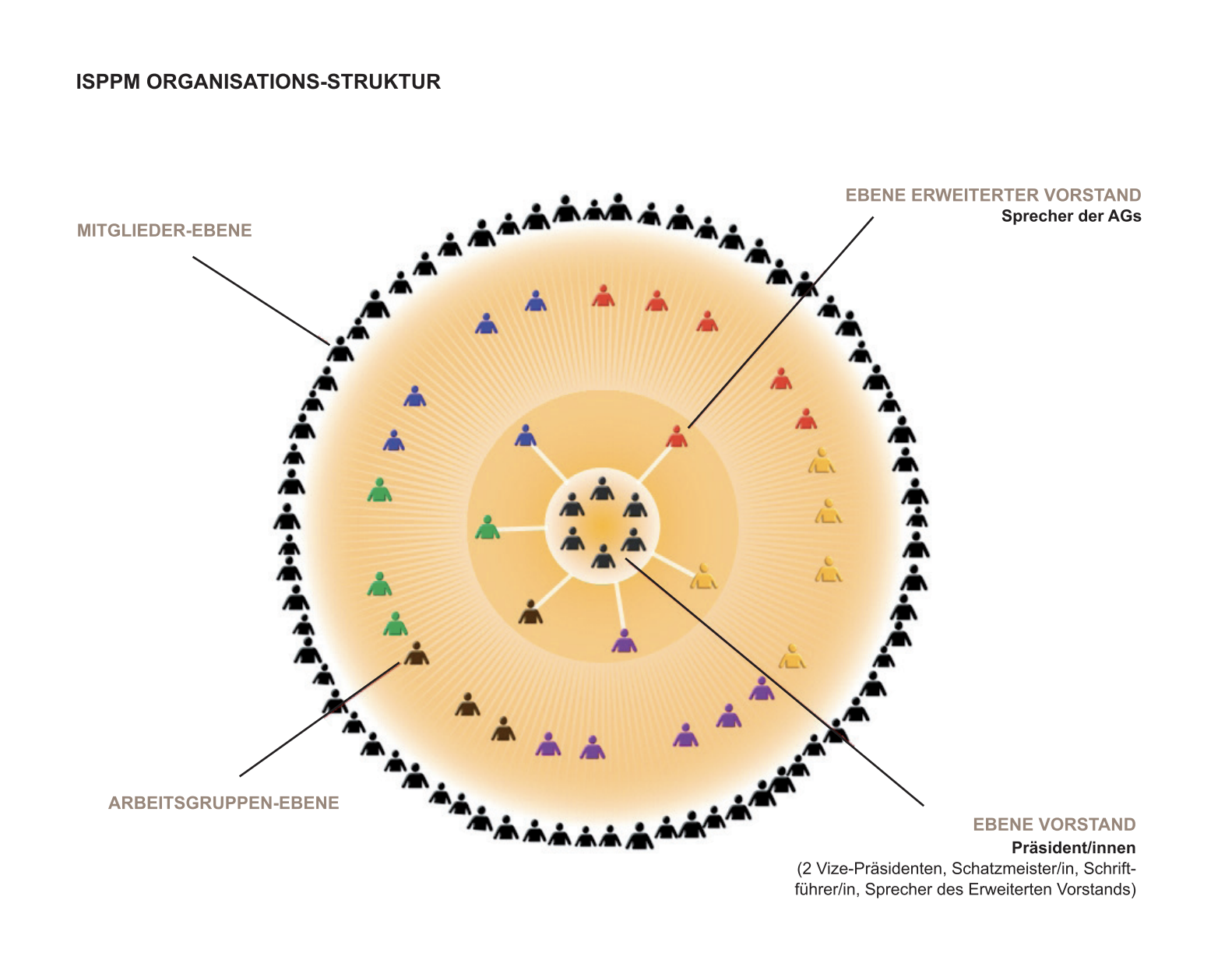
International Society for Prenatal and Perinatal Psychology and Medicine (ISPPM eV)
THE BOARD TEAM

Hakan Çoker
Vice-President





International Society for Prenatal and Perinatal Psychology and Medicine (ISPPM eV)
Extended Board
The Extended Board is a body appointed in accordance with the statutes, which expands the organizational work of the Board to include content corresponding to the association’s objectives. Its members are confirmed by the General Assembly. They address socially relevant tasks within the framework of the association’s goals. They introduce themselves here with their self-chosen areas of responsibility and invite you to learn about specific topics.
The Extended Board consists of
the Scientific Advisory Board
the delegates of associated associations and associations that are members of ISPPM
the delegates of the country groups
the delegates of ISPPM associations from other countries
the Working Group for Prenatally-Based Psychotherapy and Psychosomatics (AG-PfPP)
Children’s Rights Delegates
contact persons for specific specialist topics
International Society for Prenatal and Perinatal Psychology and Medicine (ISPPM eV)
Scientific Advisory Board
The Scientific Advisory Board supports the Board with scientific contributions, moderates ISPPM’s scientific discourse, and conducts the peer-review process for the publication of the “European Journal of Prenatal and Perinatal Psychology and Health.”
Meanwhile, the research into the scientific foundations of prenatal psychology has become a recognized independent field that examines psychological and neurophysiological processes of the earliest stages of life and attempts to explain observable psychological phenomena. For this purpose, empirical research methods are used for controlled observation and targeted experiments in humans and animals – for example, reactions of the unborn child to external stimuli such as music or touch (ultrasound, heart rate) or the investigation of long-term effects of maternal stress on child development. Experiments deal, for example, with the effects of maternal stress on child development (behavior, learning ability, stress reactions, hormone balance, growth). Despite all reservations about controlled experiments (especially in animals), the scientific foundations of pre- and perinatal psychology and medicine are of great importance for understanding, further developing, and gaining acceptance for our work.
Among other things, the task of the Scientific Advisory Board is to evaluate published studies in prenatal and perinatal psychology and to utilize them for our work.
The following topics currently appear particularly relevant:
Development of consciousness, perception, cognitive competencies (attention, thinking, learning, memory, language), action, personality, etc.
Behavior and experience of the child before, during, and after birth
Normal and disturbed mother-child interaction before and after birth
Sociocultural differences
Effects of pre- and postnatal stimulation (music, touch, light, etc.)
Adverse environmental influences (drugs, smoking, noise, pollutants, medications)
Effects of stress, anxiety, emotions, negative maternal attitude, etc.
Birth stress, birth trauma (C‑section, premature birth, separation from mother, noise, bright light, medical and nursing interventions)

International Society for Prenatal and Perinatal Psychology and Medicine (ISPPM eV)
Consultation and support in association management, administration, legal processes, and technical infrastructure
I advise and support the Board in association management as well as in organizational, administrative, and technical matters. Furthermore, I assist with questions and challenges concerning the legal infrastructure of the association and with the maintenance of the website and server, as well as the development and upkeep of the ISPPM Journal.

International Society for Prenatal and Perinatal Psychology and Medicine (ISPPM eV)
Specialist Working Groups
The members of the Extended Board are elected for three years. Within the association’s objectives, they engage in socially relevant tasks. Here, they introduce their self-chosen fields of activity and invite you to explore their specific topics. At the end of each contribution, you will find a selected bibliography.
ISPPM Project in cooperation with Mother-Hood: Helpline
The “Helpline” project has existed since 2020. It is a cooperation between ISPPM and the Mother Hood e.V. association. The helpline offers support for women who need to talk after difficult births.
15 ISPPM specialist counselors (on rotation) volunteer to provide advice on the helpline twice a week.
www.hilfetelefon-schwierige-geburt.de
If you would like to participate as a counselor for the helpline, please contact:
LITERATURE ON THE TOPIC
Diederichs Paula, Bogensperger-Hezel Eva, Weiffen Anja (2017) Embodiment of femininity during the period of becoming a mother and being a mother. In Krüger-Kirn Helga, Schroeter Bettina (Eds) Psychosozial
Diederichs Paula, Mathea Sabrina, Weiffen Anja, (2016) Traumatic birth experience of women and its effects on mother-child interaction. In Harms Thomas (Ed) Body psychotherapy with infants and parents. Psychosozial
Diederichs Paula, Olbricht Vera (2002) Our baby cries so much! What parents can do. Kösel



Prenatally-Based Psychotherapy and Psychosomatics (AG-PfPP)
“Prenatally-Based Psychotherapy and Psychosomatics” is based not only on observations in psychotherapeutic situations but also on the results of empirical sciences regarding the effects of prenatal stress, prenatal programming, early brain development, birth dynamics, epigenetics, etc. In this sense, it is interdisciplinarily founded. Its observations therefore also have implications for other scientific and practical areas surrounding pregnancy and birth. Thus, knowledge of the psychological significance of early developmental conditions has significantly influenced the approach to birth and pregnancy in particular. This is especially true for the comprehensive change in the care of premature infants.
Read more about
- Conceptual Frameworks of “Prenatally-Based Psychotherapy and Psychosomatics (PfPP)”
- PfPP Model in Adult Psychotherapy
- PfPP Model in Child Psychotherapy
- PfPP Model in Gynecological Consultations
- The PfPP Model in Art Psychotherapy
- The PfPP Model in Body Psychotherapy
- The PfPP Model within Regression Psychotherapy

Children’s Rights Representation in the National Coalition Germany of ISPPM e.V.
The UN Convention on the Rights of the Child (CRC) is an international legal agreement.
The “Charter of the Rights of the Child before, during and after birth”, however, was developed within the ISPPM society and adopted in 2005. The international legal agreement lacks clarity regarding prenatal life. Therefore, in 2014, ISPPM became a member of the “National Coalition Germany – for the implementation of children’s rights into national law” – to bring the content of the ISPPM Charter to the national and international level of the UN Committee on the Rights of the Child.
The UN Convention on the “Rights of the Child” up to the age of 18, adopted on 20.11.1989, was a historic step because the child was recognized in its own rights. The child was no longer seen merely as a not-yet-adult, but as an independent human being and an independent human person with a right to care, protection, safety, and participation. The UN Convention on the “Rights of the Child” guarantees developmental rights that are intended to allow the child to unfold its full potential.
In 1992, the Federal Republic of Germany ratified the UN Convention on the Rights of the Child.
In 1995, the National Coalition (NC‑D) was founded in Germany as a network of civil society organizations (NGOs),
In 2013, the NC‑D was re-established as a registered association to promote the implementation of the UN Convention on the “Rights of the Child” in public and to make it clear to decision-makers at federal, state, and municipal levels what obligations arise from the UN Convention on the Rights of the Child and what efforts must be made in Germany and in international cooperation to realize children’s rights. 110 associations and organizations (e.g., Deutscher Kinderschutzbund, Deutsche Liga für das Kind, Familie und Gesellschaft, Pestalozzi-Fröbel-Verband, etc.) are united here.
ISPPM e.V. has been a member of the National Coalition Germany (NC‑D) since 2014.
In 2016, the General Assembly of ISPPM elected a delegate with the task of representing the ISPPM Charter “of the Rights of the Child before, during and after birth” in the NC‑D, in order to draw attention to the importance of the child’s prenatal and birth developmental period in national and international public.
Marita Klippel-Heidekrüger has held the unanimously elected mandate ever since.
Research into early child development, as conducted and discussed particularly within the
- International Society for Pre- and Perinatal Psychology and Medicine (ISPPM) and the American Association for Prenatal and Perinatal Psychology and Health (APPPAH), demonstrates that the individual and social life of the child begins even before birth. The period before, during, and after birth should be considered a continuum in which various developmental and learning processes are intertwined, interdependent, and interrelated. The foundation of our basic feelings of security and trust is laid during this time. A fundamental prerequisite for healthy development is a reciprocal relationship between mother and child, the father, and the social community. Different models of mutual influence occur in various cultures. The child before birth is thus a human being and part of the whole within its respective culture.
From conception, a child has rights.
The following Charter of the “Rights of the Child before, during and after birth” attempts to make these rights concrete. This involves fundamental emotional, physical, and mental needs that must be met as a prerequisite for a child’s healthy development.
Of course, these rights are also related to the rights of other persons, especially those of the mother and family. It is necessary to find a balance between them with an understanding of the underlying different needs of all, including those of children. ISPPM e.V. recognizes the uniqueness of pregnancy and birth from the very beginning. It speaks of a MOTHER/CHILD unit and always proceeds from the biographically significant situation experienced jointly by mother and child during pregnancy.
Before presenting the rights of the pre- and perinatal child from the perspective of ISPPM e.V., a note on the pregnancy conflict, which is regulated in
§ 218:
Regulations in individual nations differ, and additions and amendments to existing law are constantly being considered.
German jurisprudence, regulated in § 218, reflects the conflict situation that can arise between a woman’s right to self-determination and the child’s right to life. Legally, it involves balancing two legal interests:
- The child’s right to life is a relative, not an absolute, right.
Its right to life depends on
the circumstances on which it is and/or will be dependent.
- A pregnant woman’s right to self-determination is a human right and, in this conflict, takes precedence over the child’s right.
The woman’s decision, whatever it may be, is respected by the state. For centuries, this was not the case. Women who decided against the child were criminalized, condemned, and even killed.
Women asserted their right to self-determination in this matter through decades of struggle.
ISPPM Charter “of the Rights of the Child” before, during and after birth
GreenBirth e.V.
In 2009, Irene Behrmann, Eva-Maria Müller-Markfort, Marita Klippel-Heidekrüger, and other ISPPM members founded the GreenBirth e.V. association.
The goal is to provide pregnant women and parents with well-founded and targeted information about the birth of a child.
In cooperation with experts at ISPPM, statements on current topics are drafted. Special attention is paid to the situation of expectant parents. The following statements have been prepared so far:
- Statement on planned blood test in early pregnancy (2019)
- Press release on the regulation that came into force on 31.12.2020 regarding
- Ultrasound in pregnancy (2019) Press release on Covid19
- and the situation of fathers in the delivery room (2020)
As a delegate of GreenBirth e.V. on the extended board, the common goal of humanizing birth culture in Germany is continued. The collaboration between ISPPM and GreenBirth serves to transfer the work of experts to the grassroots (parents).
If you would like to contribute to this transfer, you are most welcome.
The delegate of GreenBirth e.V. is Elke Mrosek. She practices naturopathic psychotherapy using the Therapeutic Regression Work (TRA) method.

Attachment Analysis e.V.
In 2002, Ludwig Janus, past president of ISPPM, met the founders of Attachment Analysis, György Hidas and Jenö Raffai, in Heidelberg and Budapest. A working group for Attachment Analysis was formed within ISPPM. The first training courses took place from 2004 in Heidelberg and later also in Austria.
From this working group, the non-profit association Gesellschaft für Bindungsanalyse nach Hidas & Raffai (Vorgeburtliche Beziehungsförderung) e.V. (Society for Attachment Analysis according to Hidas & Raffai (Prenatal Relationship Promotion) e.V.) was founded in 2020, aiming to embed the method in public and health awareness.
The training now takes place at various locations in Germany, Austria, and Switzerland. Further information at www.bindungsanalyse.de
Today, a delegate represents the association on the extended board of ISPPM and continues the cooperation.
LITERATUR ZUM THEMA
Raffai Jenö, György Hidas Jahr:
Nabelschnur der Seele. Psychosozial
Balkenhol Christa, Karrasch Christine (Eds) Year:
With your love, my soul grows. Harmony
Further literature under Literature References on bindungsanalyse.de and in the
Int. Journal of Prenatal and Perinatal Psychology and Medicine – Bindungsanalyse

Focus: Cultural Psychology
The roots of prenatal psychology lie in psychoanalysis, which from the outset also had a cultural-psychological claim. Meanwhile, it is undisputed among prenatal psychology experts that the human psyche is capable of making prenatally, engrammatically stored body memories accessible to consciousness through symbolic images via altered, regressive states of consciousness.
Central archetypes or universal symbols of humanity’s cosmogonies include the World Tree, the Serpent, the Axis Mundi (World Axis), the World Mountain, the Cave, the Sacred Spring. These symbols of the sacred, which are associated with the creation of the world, are easily identifiable as memories of prenatal experiences.
The Cultural Psychology Working Group within isppm e.V. discusses these findings and connects them with matriarchy research, psychohistory, conflict research, art history, anthropology, and other scientific disciplines. This has led to numerous publications and several conferences, which originated from the initiative of Dr. Ludwig Janus within the framework of the German Society for Psychohistorical Research.

Traumaprävention
The focus on trauma prevention aims to destigmatize the topic of birth trauma. Activities should help to avoid psycho-trauma before/during and after birth (for mother/child/families).
Measures and activities support and serve to ensure that mothers/children/fathers/families can go through and emerge from a birth as physically and psychologically healthy as possible.
Coming soon for Austria: Offers related to birth trauma

Premature babies and their parents
Prof. Dr. Otwin Linderkamp and his colleague Marina Marcovic introduced relationship-based neonatal care in the 1980s and practiced it successfully. The “born unborn”—as psychologist Sabine Schlotz calls them—develop better with less damage if the premature baby can lie on the chest of the mother, father, etc., as often as possible and experience closeness, warmth, and love from the caregivers they left too early. The aim is to pass on the knowledge of prenatal psychology and prenatal bonding promotion (bonding analysis) to parents who are at risk of premature birth or who have given birth to a child prematurely, so that they can support their child as best as possible against this background and promote their psychological and physical development, keeping the consequences of early birth as low as possible. Further training for professionals is available on request.

Prenatal psychological and psychosomatic support in midwifery
As a long-standing home birth midwife, I would like to contribute my experience from out-of-hospital work (freelance) in caring for pregnant women, mothers during the hours of their delivery, and then in the postpartum period together with their small newborn.
Today’s field of activity for midwives primarily takes place in clinics. As a result, obstetric medical handling is increasingly taught, which interferes with the mother-child dyad with serious consequences for the small unborn child.
In this context, prenatal psychological and psychosomatic knowledge regarding pregnancy, labor, and birth receives special attention.
The work of the midwife dates back to the beginning of human history. Much of what she does is timeless, passed down through generations.
She was a counselor—even for unfulfilled desires to have children—and accompanied women through the months of pregnancy, standing by mothers in the difficult hours of delivery with her knowledge and skills. She accompanied the new mother in the early days of the postpartum period, helped her in handling the newborn, and cared for the small child when it needed special attention. And she provided comfort in cases of premature births and deceased children.
However, over time, the manner of giving birth has also changed, to the detriment of birth culture. We must find the way back to midwifery where medical assistance is not required.
The out-of-hospital practice of the midwifery profession is particularly suitable for a paradigm shift in dealing with the mother and her unborn small child. We have a unique opportunity to help mothers gain a new perspective on their bodies, their emotional lives, and their small child and its emotional life.
Mothers find this completely different type of prenatal communication with the little child they carry under their heart to be very fulfilling and strengthening. They are confirmed in the conviction that they can give birth to this child well. The small child, in turn, is certain of its mother’s support and can thus embark on the path to life outside with confidence in the mother’s help.
Cooperation with ISPPM Switzerland
ISPPM Switzerland is an independent association. A delegate from the AG-PPP Switzerland represents Switzerland as the national representative at ISPPM e.V.
Its task is to discuss central themes and concerns from prenatal and perinatal psychology and medicine and to adapt and disseminate them according to the national and local social conditions in Switzerland.
ISPPM Switzerland pursues five goals:
1. Individual members from Switzerland should be brought into contact with one another. The development of a network consisting of people familiar with the local health policy and socio-cultural conditions in Switzerland should be promoted.
2. National experiences should be brought into ISPPM e.V. and discussed there. From this, new goals can be developed and activities implemented in a European or national context.
3. The Switzerland working group seeks exchange with other national groups within ISPPM e.V.
4. The Switzerland working group is in constant exchange with ISPPM Switzerland. Here is the link to their website: www.isppm.ch
5. The Switzerland working group networks with other associations with a prenatal and perinatal background, such as GAIMH.
The goals of ISPPM e.V., ISPPM Switzerland, and GAIMH are very similar. All are concerned with the needs of pregnant women and families with small children. Since the annual conferences in Zurich in 2015 and Kreuzlingen in 2018, GAIMH has also focused on ensuring that prenatal and perinatal perspectives are considered. Since 2017, there has been an active working group for prenatal psychology and medicine within GAIMH.
Ursula Gehre-Staffiero
Gemeinschaftspraxis Gehre
Craniosacral Therapy & Integrative Baby Therapy
Zürichstrasse 135
CH-8910 Affoltern am Albis
Väter
The central questions are:
- What challenges do fathers face when their wives and babies have experienced emotionally distressing births?
- What influence does the father have in positively affecting the experiences surrounding birth?
In recent years, psychotrauma in connection with births has increasingly come to the attention of professionals and the wider public, receiving urgently needed basic consideration. However, the focus has predominantly been on babies and mothers—fathers have remained largely ignored until now.
However, the father has a very significant role when women and babies have experienced emotionally distressing births: It can be assumed that the number of unreported cases of men who experienced the birth of their own child as violent and as an existential threat to their wife and baby is very high. These fathers felt helpless and powerless during the birth. In some phases of human development, the man was responsible for protecting the family in challenging situations. Through the experienced helplessness, the man thus enters a situation that is incompatible with his evolutionary and social role: He has not sufficiently fulfilled his task of protecting his wife and child.
This can lead to a feeling of powerlessness and shame; as a result, some men are no longer able to speak about the birth and suppress the experiences. Their own needs and the needs of the wife and child after an emotionally distressing birth are no longer adequately perceived and/or the man is unable to respond to them to a sufficient extent.
Ideas and measures are being developed to support fathers in their important role.
Contact: Swen Galster swen.galster@gmail.com